MLPs (Feed-Forward Networks)
Short for Multi Layer Perceptrons. They are one of the simplest forms of neural networks. With multiple layers (which is basically a bunch of neurons) that link together via weights and biases to output a result.
![[MLP.webp]] Source
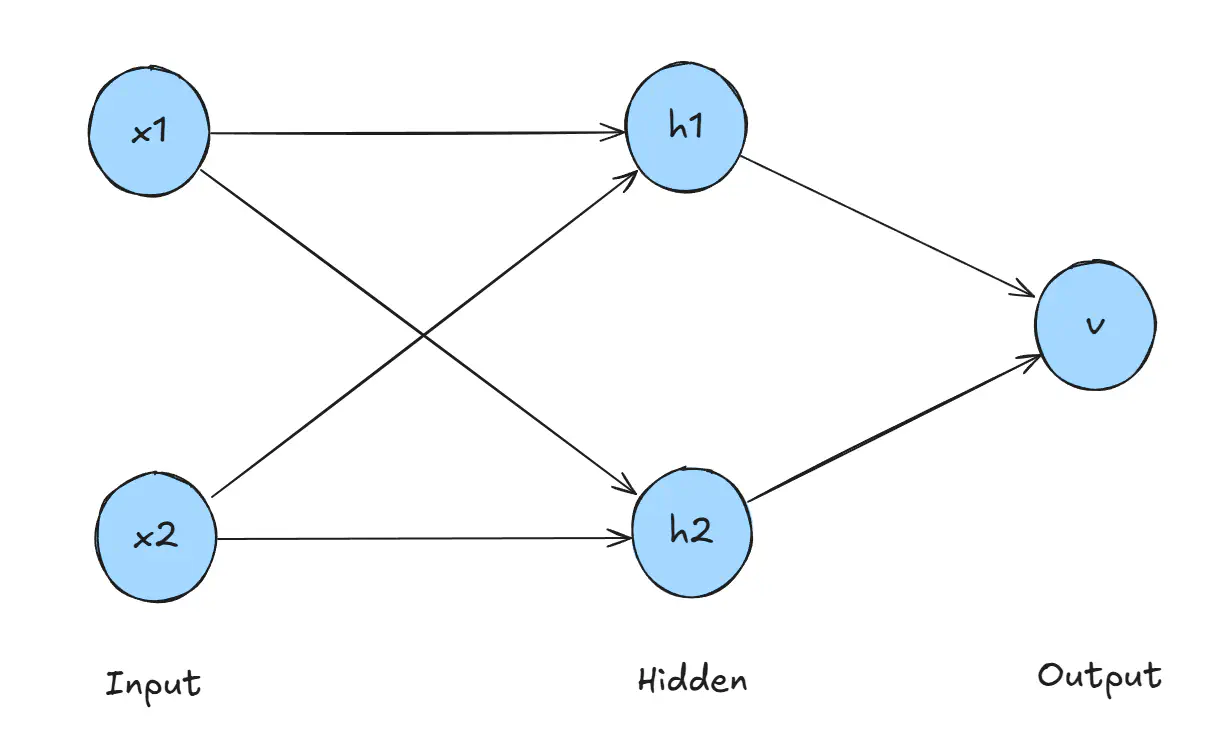
As we can see in the picture, each “column” of neuron(s) is a layer, each layer can have a arbitrary amount of neurons. There are three different types of them, as noted by the picture:
- Input Layer: The values of the neurons in the input layer are simply the input values, so they are basically just registers that store the input data that will be passed onto the hidden layer(s).
- Hidden Layer: Where the magic happens, they shape the values passed in via their biases, weights, and activation functions.
- Output Layer: The layer where all the data gets funneled in and does a final calculation of $(\sum_{i=1}^{n}w_ix_i)+b$ (passed through the activation function) and outputs them.
MLPs are in a lot of networks, they are perhaps the simplest neural network out there, the feed-forward layer in the modern LLMs is also something resembling a MLP.
[!NOTE] The output layer might go through a final function: Softmax; defined as such: $f(x_i)=\frac{e^{x_i}}{\sum_{j=1}^{n}e^{x_j}}$1. It converts all the “logits” (basically the non-normalized outputs of the model in the final layer) to a probability distribution between 0 and 1
#ai #ai/conceptual
-
$x$ is the vector of the values of the output neurons, $i$ is the $i$-th element in it ↩